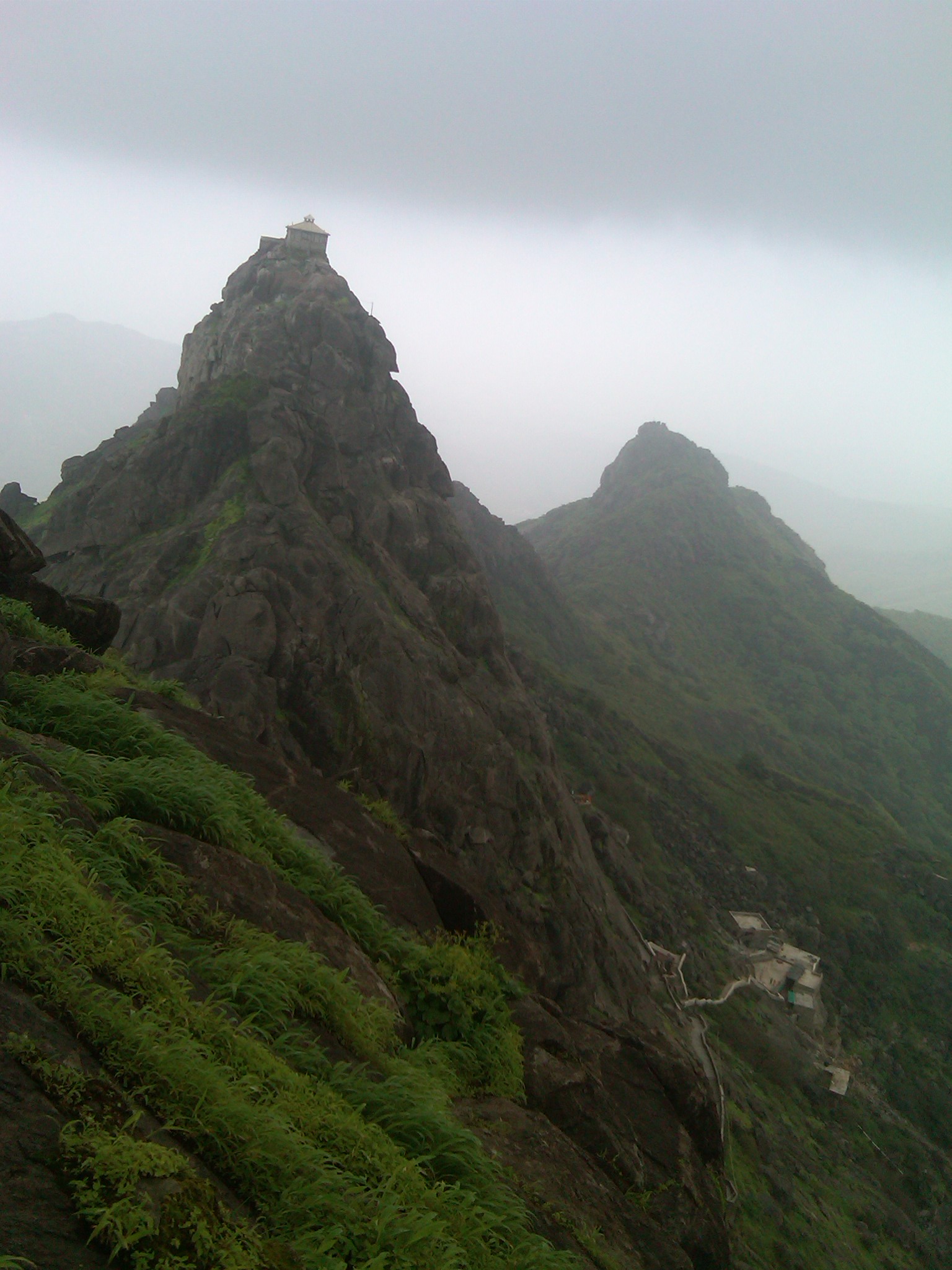
Rising more than 1,000 metres above the plains outside Junagadh in Gujarat, Mount Girnar is among the oldest mountain ranges on Earth — older, geologists say, than the Himalayas themselves. But it is not its age that draws pilgrims to its slopes by the hundreds of thousands each year. It is what waits at the very top: the shrine of Sadguru Dattatreya, reached only after a climb so demanding that reaching it has always been understood as an act of surrender in itself.
The Peak Where the Guru Still Walks
Of Girnar's five principal peaks, the highest and most difficult to reach is crowned by the temple of Dattatreya — the Guru who is Brahma, Vishnu, and Shiva in one form. The final approach is a narrow, punishing stretch of stone steps carved directly into the rock, often wrapped in cloud, where the mountain itself seems to test whether a pilgrim's devotion is equal to the climb. It is this remoteness, more than anything, that gives the shrine its power in the hearts of devotees: nothing about reaching Dattatreya at Girnar is easy, and that is precisely the point.
The Belief That He Still Wanders the Mountain
Among devotees of the Datta tradition, one belief is repeated more than any other: that Dattatreya has never truly left Girnar. He is remembered as the eternal Avadhuta — the wandering, form-transcending ascetic — and it is widely held that he still walks the mountain even today, appearing to sincere seekers not as a deity in splendor, but disguised as an ordinary sadhu, a tired traveller, or a stranger met unexpectedly on the steps. For this reason, pilgrims climbing Girnar are traditionally taught to greet every soul they pass on the mountain with respect — because the one offering water, or a kind word, on that long climb may, in ways unseen, be Dattatreya himself.
Chamatkars of the Mountain
It is this belief that has given rise to generations of chamatkar — miracle — stories among Girnar's pilgrims. Devotees speak of exhaustion lifting suddenly on the final steps, of unexpected help appearing exactly when the climb felt impossible, of long-standing problems in their lives dissolving in the months after a sincere visit to the summit, and of a profound sense of peace that pilgrims describe as unlike anything felt elsewhere — as though the Guru's grace becomes tangible the moment one steps into his presence at the top. The sacred ash (vibhuti) from the dhuni at the shrine is carried down by pilgrims and treasured for its blessings, and many devotees return to Girnar year after year, convinced that a prayer made with sincerity at Dattatreya's peak does not go unanswered.
A Mountain of Hidden Siddhas
Girnar's reputation extends beyond the summit shrine itself. Local tradition holds that the mountain's forests and caves are home to countless hidden siddhas and ascetics who have quietly performed tapasya here for generations, unseen by the pilgrims climbing past — a living echo of the Nath yogi tradition centred nearby at Gorakh Shikhar. It is often said that Girnar reveals itself differently to each person who climbs it: as scenery to one, as endurance to another, and as unmistakable grace to the devotee who comes seeking the Guru with an open heart.
A Living Presence, Not a Memory
What makes Girnar's Dattatreya shrine so cherished is that, for devotees, it is not a monument to a story from the past — it is a place where the Guru's presence is still felt as living and immediate. For an ashram carrying Dattatreya's name, Girnar is not a distant place read about in scripture, but a reminder, standing in stone, that the Guru principle is not confined to any one form or century — and that it continues, quietly, to answer whoever climbs toward it in faith.