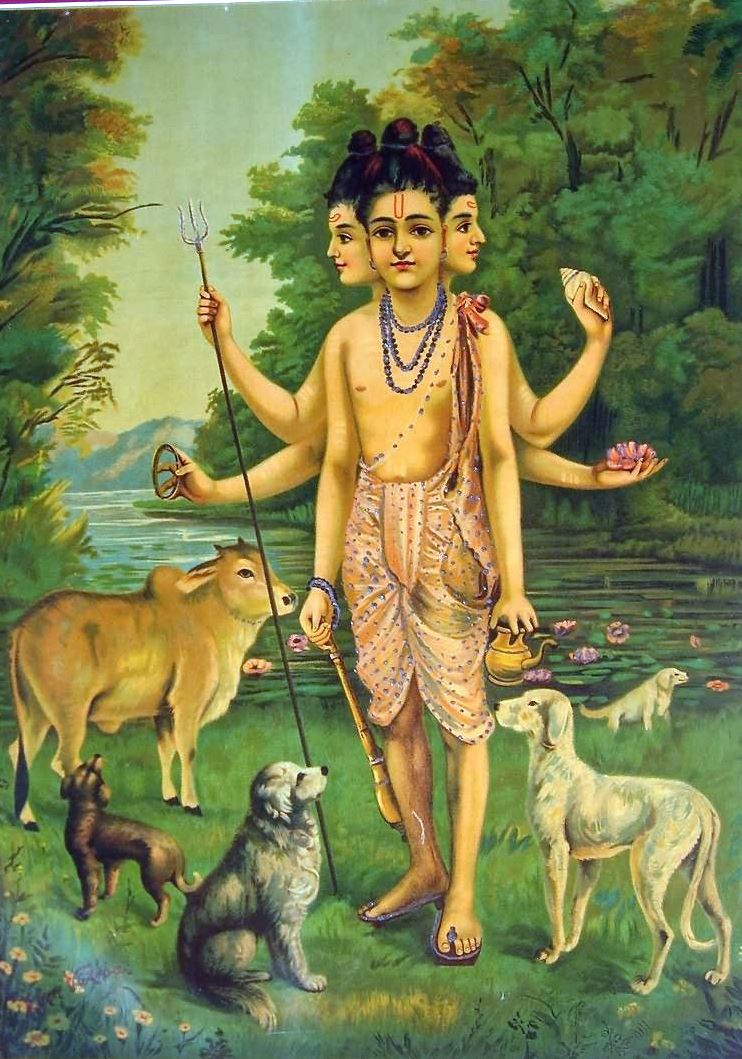
Among the most revered figures in Sanatana Dharma, Sadguru Dattatreya occupies a singular place — worshipped not merely as one deity among many, but as the very embodiment of the Guru principle itself. He is described in scripture as Trimurti Avatar: a single form uniting Brahma the creator, Vishnu the sustainer, and Shiva the destroyer, born to the sage Atri and his wife Anasuya in answer to their penance and devotion.
The Form That Teaches at a Glance
Dattatreya's iconography is itself a teaching. He is most often depicted with three heads and six arms, accompanied by four dogs and a cow standing quietly at his side. The three heads represent the three great functions of the universe — creation, preservation, and dissolution — held together in one being, showing the seeker that these are not separate forces but a single, unified reality. The four dogs are traditionally understood to represent the four Vedas, ever-faithful and always near their master. The cow is Kamadhenu, the wish-fulfilling mother, symbolizing the earth itself and the boundless, unconditional nourishment a true Guru offers every being who comes to them.
Adi Guru — The Guru of Gurus
What sets Dattatreya apart in the devotional and philosophical tradition is his role as Adi Guru, the original teacher from whom all lineages of spiritual instruction are said to descend. The Bhagavata Purana tells of Dattatreya explaining to King Yadu that he had no single human teacher — instead, he learned from twenty-four gurus found in the natural world: patience from the earth, non-attachment from the sky, purity from water, single-minded devotion from a young unmarried girl absorbed in her work, discipline from an arrow-maker so intent on his craft that a procession passed unnoticed before him, and much more, down to the humble honeybee, the moth, and even a courtesan. Each teacher was ordinary; what made them a guru was Dattatreya's willingness to observe, and to learn, from anything and anyone. It is one of the most democratic and quietly radical teachings in the tradition — that wisdom is everywhere for the one who is ready to see it.
Datta Sampradaya and the Guru Charitra
Across Maharashtra, Karnataka, Andhra Pradesh, and Gujarat, an entire devotional tradition — the Datta Sampradaya — has grown around him, with Dattatreya honored as having incarnated in later ages as Shri Shripad Shrivallabha and Shri Narasimha Saraswati, whose lives are recorded in the widely read Guru Charitra. His birth is celebrated each year on Datta Jayanti, the full moon of Margashirsha, with recitation, bhajan, and the offering of the traditional twenty-four-wick aarti in his honor.
Girnar and the Living Presence of Dattatreya
In Gujarat, Dattatreya's presence is felt most powerfully atop Girnar hill in Junagadh, where a temple to him crowns the highest of Girnar's peaks after a demanding climb of thousands of stone steps. For centuries, sadhus, sannyasis, and devotees have undertaken this ascent as an act of surrender, and the hill remains one of the most significant Dattatreya pilgrimage sites anywhere in India — a living reminder that the Guru's presence is not confined to scripture, but can still be sought, step by step, by anyone willing to climb.
A Simple Invitation
Dattatreya's teaching is, at its heart, an invitation rather than a doctrine: to stay humble enough to learn from the world around us, and to recognize that the Guru's grace is not distant, but as near as our own willingness to receive it. May his blessings guide all who walk this path.
Jai Guru Dattatreya.